

“How do we get started on LinkedIn?”
This was the question thrown my way by a small team working for a multi-national enterprise. They noticed that their colleagues followed LinkedIn more actively than even official Slack channels. Plus they wanted to raise their team’s profile in the industry. But they’d had limited experience with the platform.
I, on the contrary, have been active on LinkedIn for years. Even published a trending write-up on Reddit about LinkedIn tactics as far back as 7 years ago. Occasionally, I still help executives and founders with LinkedIn — mostly as part of a broader communication strategy.
So the question led to me doing a “LinkedIn 101” workshop for this team. I recorded the whole event, transcribed with rev.ai, then asked Gemini to extract all the practical tips from my speech. I thought I would publish it with minimal polishing. But the model missed many points and missed the point of many of the points it didn’t miss. I ended up rewriting 90% of the whole thing.
The AI experiment failed. But I still got this guide for growing your LinkedIn profile from zero to something. A warning: it’s highly opinionated. As a 40-something man with a diverse experience in business and writing I stand for sustainable growth over hacks and hustle.
Part I. The mindset

1. Treat online like offline
If you follow all the advice about how you should grow on LinkedIn, it can lead you to pretty dark places. How should you differentiate between good and bad advice? A rule of thumb: just don’t do on LinkedIn anything you wouldn’t do in “real life.” For example, you probably wouldn’t come to a party to start selling and pitching the moment you cross the threshold — so you probably shouldn’t do it on LinkedIn either. You probably wouldn’t talk about yourself all the time — so you probably shouldn’t do it on LinkedIn.
2. Be real
Sometimes it feels like you need to reinvent yourself to get real traction, become similar to that “influencer” who seems to be killing it on LinkedIn. I humbly suggest that you ignore this feeling. Aim to minimize the distance between the online image you create and your authentic self. If you manufacture a persona that is totally different from who you are, it will eventually lead to burnout. Or a jarring disconnect when people finally meet you in person.
3. Avoid transactional relationships
In the offline world, we avoid people who are purely mercantile and transactional — those who only talk to you because they want something. Yet, online, people often feel it is fine to treat others as mere leads. But why should it be different? Relationships are built on genuine interest, not just immediate gain.
4. Detach your identity from metrics
It is vital to mentally separate your self-worth from the number of likes or views you receive. If a post flops, it doesn’t always mean it’s bad. Most likely the algorithm just didn’t pick it up for some reason. And if your posts don’t trend at all, it is simply because your account isn’t “warmed up”. Just as a reminder: there are doctors saving lives every day out there who have no followers on LinkedIn whatsoever.
5. Recognize the “silent fans”
This might help a bit with point 4. LinkedIn is a platform where many people hang out without interacting. Because their professional reputation is tied to their profile, many are hesitant to publicly “like” or comment on posts, yet they are still reading them. You might have people following you for years who never click “like” until one day they reach out and offer a deal. Happened more than once with me.
6. Prioritize consistency over intensity
A common mistake is treating LinkedIn like a sprint rather than a marathon. People often get super excited and hyped, post five times a day for a few weeks, burn out, and then disappear for two years. It is far more effective to do “less but better” over a long period. Consistency builds a lasting reputation. I think for most people posting once or twice a week is more than enough.
7. Aim for a net positive effect
Before you engage or post, ask yourself if your activity makes the world — or at least your professional community — slightly better. Are you adding value or noise? With AI slop flooding the internet, this is even more relevant than ever. If the answer is “yes,” go ahead. If the answer is “no,” it’s a signal to pause and reconsider.
Part II. Getting started: profile

8. The why
Just like with anything in life, everything starts with the goal. You need to know what you are trying to achieve. Common goals people pursue on LinkedIn: building a brand to get a new job or boost career in general, motivating and communicating with the team (see above - in enterprise, people often read LinkedIn more than internal platforms), building the employer’s brand, raising profile among investors or partners and, finally finding clients. Some people are just having fun. Be realistic and honest. There is no wrong answer here — as long as you have it.
9. Define your audience before you type
Once you know your “why,” you will know who you are speaking to. It will impact how you tell your stories. Just a general storytelling principle: you tell the same story differently to your mom, your friend, and your boss because their context and the language they speak differ. A lot in comms depends on understanding what your audience knows, thinks and feels — because only based on this understanding your can expand their knowledge, challenge their thinking and engage with their emotions. You need to know the baseline.
10. Imagine you’re talking to real people
Instead of targeting a vague demographic like “CEOs and founders of series A companies in the X industry,” pick 2-3 real people you actually know who represent your audience. From now on, you’ll be talking to them — in your head. Test everything you do against them.
11. Revamp your profile
Your first exercise: imagine these 2-3 people open your profile. If they didn’t know you, would they be interested to connect? Is it clear who you are and what you do — and what you’re going to write about? There are consultants who specialize in profile optimization. They do it 24/7 — only profiles, nothing else. I find their advice sometimes too strict — and sometimes questionable. I don’t think you need to over-optimize. You need an adequate photo, clear headline and good-enough bio — guided by your understanding of those 2-3 people. That’s it.
12. Don’t use tools — and don’t share your account
One final note before we get going. There are apps that can track people on LinkedIn and automate commenting and posting. Don’t use them. Do as much as you can natively on the platform. The LinkedIn algorithm has lots of way to differentiate “normal” users from bots and supposedly tracks everything - for example, how long you read the post before commenting. When posting/commenting via a tool, you basically deprive the algorithm of all this info. Not to mention that many tools are “gray hat” solutions with an added risk on its own. And by the way, sharing your account, for example with a PA, might be also detrimental. Especially when you log in from San Francisco and your PA logs in is from the Philippines at the same time.
Part III. Network before your post

13. Social media isn’t about broadcasting
A common mistake people make in the beginning: they jump right into pushing their content without interacting with others. If you do this, you are missing the point of social media. Social media isn’t a broadcasting platform like television. It is a space for dialogue. So you must engage with other people’s ideas if you want them to eventually engage with yours. In the long-term, your effort should be split 50/50 between sharing your stories and engaging with others.
14. Join the conversation before you lead one
If you haven’t been active on LinkedIn at all, it’s worth doubling down on engaging with other people for at least a month or two. Entering LinkedIn is like entering a room full of people. You shouldn’t immediately stand on a chair and make a speech. The smarter first step is to join existing conversations. So in the beginning, your comments/posts ratio should be about 90/10.
15. Don’t rely on the algorithm
The algorithmic feed can hide posts from people you actually want to see. Or it will show a valuable post to you but you get distracted and navigate from it to never see it again. To ensure you catch the important conversations, go to the profiles of industry leaders or relevant peers and click the “bell” icon. There you can enable notifications for all or most relevant posts. You can also keep a list of profile links to check them manually.
16. Yes, you should spend time commenting
The fastest way to build visibility when you have a small network is to comment on the posts of industry leaders. These people already have the audience you want. By leaving interesting comments on their posts, you become visible to their followers, which is often more effective than “talking to an empty room” aka posting on your own profile.
17. Grow your network with a sniper rifle — or a machine gun
Grow your network every day. It’s safe to send up to 100 connection requests a week. There are 2 main strategies. You can adopt a “sniper” approach, where you only connect with a few high-value people you know or really want to meet. Or you can use a “machine gun” approach, sending requests to anyone remotely relevant to build numbers quickly. Both strategies work, both have pros and cons. If you use the machine gun approach, monitor your acceptance rate. If too many people ignore you or report you, the platform will view you as a spammer. Overall, choose the strategy that fits your comfort level and goals.
18. Skip the custom connection note — or not
Some advise writing a custom note for every connection request. It definitely helps with increasing the acceptance rate but might be time-consuming and yielding diminishing returns. It is usually more efficient to send a connection request without a note and then engage meaningfully after they accept. This works just fine especially when you “networking down” (CEO/founder reaching out to executives) rather than “networking up.”
19. Find contacts in your network
How can you find new contacts? Start with the relevant people who are already in your network. Most users allow you to see their contacts, so you can find more relevant people this way (go to Profile → Connections). Every time you add someone to your network, you can check their connections this way. Then pay attention to the people liking and discussing relevant posts. These are active, engaged users who are interested in the topic. Later, when you start publishing your stories, check your own posts to see if there is anyone not in your network. If they engaged with your content, it’s likely they’d accept your invitation to connect.
20. Send a warm welcome after acceptance
Once someone accepts your connection request, that is the perfect time to reach out. A short, genuine message saying, “Thanks for connecting, I really enjoyed your recent post about X,” sets a warm, human tone for the relationship without feeling like a sales pitch. Signaling that you aren’t selling anything is also beneficial.
21. Never use AI for comments
There are many tools now that automate comments using AI, filling posts with praise - or echoing what the author just said. Everyone hates this. It’s obvious, insincere, and damaging to your reputation. Far better to write five words of your own broken English than a perfect paragraph generated by a bot. These days the script completely flipped: sometimes dropping just “Congrats, man” is much better than dumping a full paragraph of pseudo-thoughtful comment.
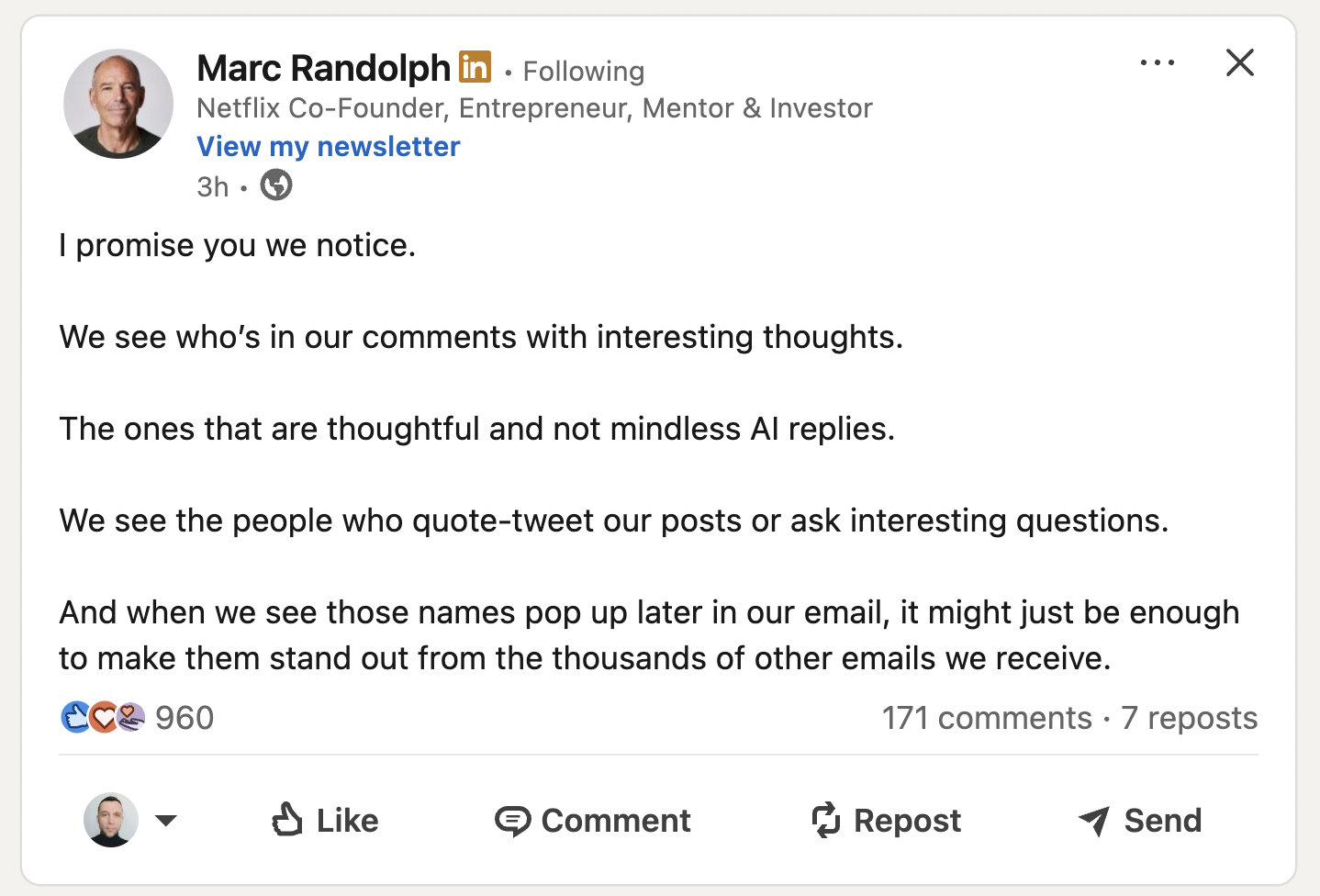
22. Be generous
If you read a post and it gave you even a moment of interest, click “like.” It costs you nothing, but it validates the creator and encourages them. Being generous with your attention creates a positive loop where people are more likely to support you in return.
Part IV. The content framework

23. The 45/45/10 Rule
Roughly 45% of your posts should be aimed at reaching new audiences. This is your best content — most valuable insights, your greatest stories. Some people call this content “viral” but I find this word unhelpful, since you never know what will go viral. Another 45% of your content should be aimed at your existing audience who chose to follow you. This is where you deliver value for your audience and build trust. 10% of the content should ask for something (sales, hiring, conversion).
24. All-in-one approach is becoming more relevant — but it requires skills
The 45/45/10 framework has been gold standard for years. This is slowly changing. The reason is that LinkedIn is now following in the footsteps of other social platforms that are heavily prioritizing viral content. A typical Instagram or Twitter feed consists mostly of the trash you never subscribed to but the algorithm decided to show nevertheless. It’s not as awful on Linkedin, but we all know where it’s going. That’s why some people argue that you have to do everything — virality, authority and conversion — in one post. But this requires skill. Don’t try to do it all at once until you are more experienced.
25. Double down on your own stories — your own proprietary data
Generic advice, even if it’s great, won’t get you anywhere these days. ChatGPT can give pretty great advice on any topic 24/7. LinkedIn is already flooded with tips and strategies and dos and donts. You stand out by sharing your own stories. Think of it as your own proprietary data. AI models are trained on all the existing knowledge. Your advantage is that you exist in the present. You are generating new knowledge and having new experiences every day. Share that, because that is the one thing ChatGPT can’t do.
26. Don’t post without a selfie — although you can get away with text-only occasionally
People want to interact with other people. This explains why they play chess online with each other — and not with AI. Although Stockfish can beat anyone — or match your skill level. The best way to make your audience connect is to add a selfie to your post. Yes, I know, text-only posts can also perform, as well as carousel of slides (uploaded as pdf), but in the age of AI, a human face is the ultimate “proof of life.”
Part V. Reaching new audiences

27. The “Story + Idea” formula
This is the oldest communication tool in human history, dating back to religious texts like the New Testament. You tell a specific, interesting story (dramatic, funny, or lyrical) and then draw a broader moral from it. This format hooks people emotionally and then delivers intellectual value. You can get away with telling just a cool story or expressing a novel idea but you’ll always have more impact when you pair them. If you think about it, this rule applies to everything - social media, books, movies. Because it works.
28. Post type: controversial opinion
A “hot take” or a controversial opinion on a relevant industry topic grounded in your own experience might be a great implementation of this “story + idea” formula. If everyone agrees with you, you probably aren’t saying anything interesting. For example, an investor argues that an early-stage startup can focus on service instead of building a product first. This flies in the face of conventional VC wisdom. But the investor bases his idea on his own story. “Service-first” was how he built his company. There is a lot to discuss — and there is no right answer. Which is a good thing.
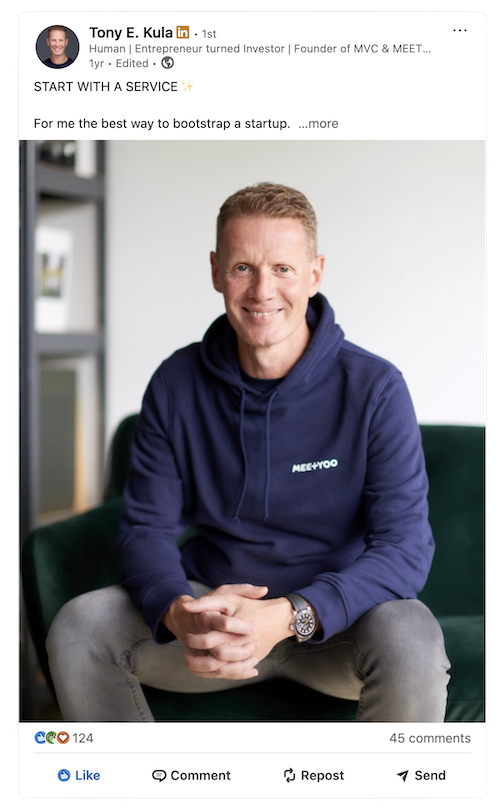
More examples: You don’t need to be first, TAM is a completely bogus concept.
29. Post type: mistakes and failures
People are terrified to look weak, but stories about mistakes, failures, and “fuck-ups” are incredibly powerful. They make you relatable and human in a sea of fake-it-till-you-make-it “success.” Sharing how you messed up and what you learned builds more trust than bragging about how smart you are. This is the most counterintuitive thing in storytelling. But it’s proven to work on numerous cases.
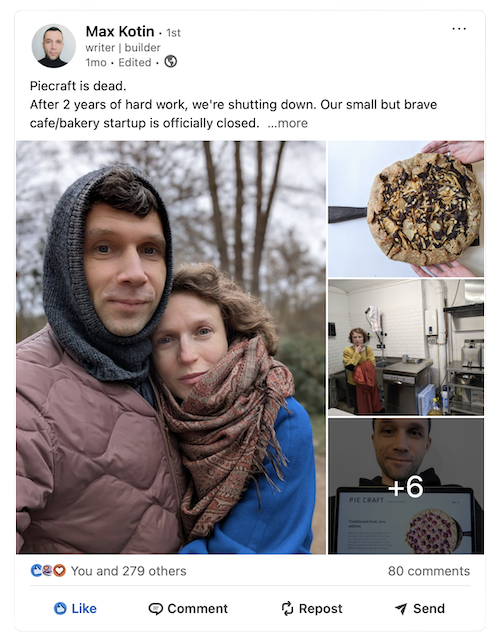
Another example: Closing curtains on Diffr.
30. Post type: consumer experiences
You are a consumer as well as a professional. Experiences you have in daily life — like a hidden fee on a food delivery app or a confusing interface in a rental apartment — can be excellent material for business content. These stories are relatable, and you can add a professional layer of analysis on top. No wonder they do well.
Examples: I sold a house a few days ago, The worst business model idea ever?
31. Post type: promoting others
The most undervalued type of stories. You can’t do this enough, you can’t overdo this. Dedicate posts to saying good things about others — a brilliant colleague, a partner who delivered, or a small business you admire. Do it sincerely, do it generously. Even if you don’t go viral, you’ll definitely improve your relations with the person in question. But chances are that the reach will be great.
Example: THIS couple turned £5,000 into a six-figure peanut butter business
32. Post type: life-changing moments
Reflect on major pivots in your life, such as moving to a new country, changing careers, or overcoming a crisis. These “hero’s journey” stories resonate deeply because they deal with universal themes of struggle and transformation, helping you reach people far outside your immediate industry niche.
Example: 9 years ago today, I moved to NYC
Part VI. Engaging with your audience

33. Post type: industry insights
Your “core” audience follows you for your expertise, so you have to provide it. This shouldn’t be ground-breaking. Just useful. A friend of mine is in foodservice and she listens to earnings calls of big food tech companies and then publishes summaries on a regular basis. It’s her bread and butter. Doesn’t go viral but performs very well and builds authority.
Example: Uber has just finished its earnings call
34. Post type: celebrate your wins
Don’t wait for a million-dollar exit to celebrate. Share even small victories — launching a feature, fixing a bug, or hitting a minor milestone. Unlike YouTube where you’ll be always trashed in comments, LinkedIn is a supportive environment. People generally enjoy cheering for progress, no matter the scale.
35. Post type: event recaps
When you attend a conference or trade show, take photos and share your takeaways. Tag a few speakers you liked or the people you met. It signals that you are active in the community and provides a natural opportunity to network with the people you tagged. But don’t overuse this tool, since if you tag too many people who won’t react to it, the algorithm will decide it’s spam.
Example: SCREW IT! Today I’m showing off
36. Post type: your team
Think about it as a variant of “promoting others” post type. You can do the same — praise others — with your immediate team. Shine a light on your employees or colleagues. Welcoming a new hire, saying goodbye to someone leaving, showing that you value the humans behind the business is crucial. This is good stuff.
37. Post type: company news with a personal twist
It’s totally fine to post company updates, but you don’t want to copy-paste the corporate text. Add your personal take — why are you proud of this? What was hard about achieving it? Your emotional connection to the news is what makes your network care about it. By the way, if you want to promote a post on a company page, don’t “share” it - just leave a comment. It will be more beneficial to the post in question but your audience will still see your text.
Example: We celebrated the opening of Chick-fil-A’s 3,000th restaurant
38. Post type: share something personal
Posting about hobbies, family, or personal struggles (like grief or parenting struggles) is totally fine on LinkedIn and even encouraged - well, in moderation. It makes you three-dimensional. A story about your kids or a personal loss can break down professional barriers and make people feel a stronger connection with you.
Example: My mom’s supported me in countless ways
Part VII. Conversion
39. Be Direct When Selling
For the small percentage of posts where you need a result (hiring, selling, downloading), don’t be coy. State clearly what you want: “We are hiring,” “Click here to buy,” or “Download the report.” Since you have built trust with your other content, your audience will be more willing to accept a direct ask.
Part VIII. Coming up with ideas

40. Spend 30 minutes to generate ideas
How do you get actual post ideas? The simplest approach: take the list of post types I shared above and try to come up with 1-3 possible topics for each genre I suggested. Even if you manage to do that only for a half of them, you’d be covered for a few weeks.
41. Reflect on your day
If you are more of a “spur-of-the-moment” type of person, you can just ask yourself at the end of the day: What happened? Did a meeting go well? Did something annoy me? Did I learn a new fact? These mundane daily moments are the seeds of your most authentic content.
42. Keep a photo diary
For some people taking pictures documenting the day can be a really great source of inspiration. When you are stuck for ideas later, scroll through your camera roll. A single photo can remind you of a thought or conversation you had that day which is worth sharing. Bonus: you’ll already have a photo to post.
43. Mine your meeting notes with AI
Many people use AI assistants to transcribe and summarize their business meetings. These files can be a great source of interesting stories. All you need is to ask any LLM to suggest topics for a LinkedIn post based on the transcript. You can even feed them the list of post types I shared above.
44. React to industry news
If you have nothing personal to share, just look outward. Read the industry news and retell the news with maybe a screenshot (not a link - you can add it in comments though) with your commentary. If you do it just in time, you can make a trending post with little effort.
Part IX. Writing and using AI

45. Craft a hook
It’s obvious but I’ll say it anyway. The first sentence is the most important part of your post. It must be short (3-5 words), punchy, and contain a hook — an intrigue, a bold statement, or a question — that forces the user to stop scrolling and click “see more.” There are millions of ways of how you can achieve it. Use your imagination and intuition.
46. Make it simple — or don’t
The default style these days is optimized for the easiness of reading. Super short sentences (1-3-5 words). Super short paragraphs (1 sentence). Lots of white space. It’s not as new as people think. Writers have been experimenting with this form for a century. These days we are all overloaded with information. So it works. But every trend is paired with an anti-trend. There are people who still write in normal “dense” paragraphs and use subordinate clauses — and they still get traction.
47. Train AI on your style
I’d advise against using AI for writing. But if you feel like you need support, I’d suggest the following. Write up to 10 posts yourself first. Then when you have an idea for a post, use a voice-to-text tool to talk about it. Then feed the transcript to Ai along with these 10 posts and ask it to write a draft based on the transcript in the style of the provided posts. Sometimes it helps to overcome the fear of a blank screen. But still you should edit the final post. AI patterns are still telling.
48. Polish grammar, not soul
AI is good for fixing grammar, especially if English is not your first language. You can specifically prompt the AI to “remove typical ESL artifacts” (English as a Second Language). Just be careful not to let it “sanitize” your writing so much that it loses your unique personality and quirks. I end up rejecting about 50% of AI edits. You can grab the ESL prompt at grabaprompt.com — it’s a free library of writing prompts.
Part X. Algorithms & tactics

49. Don’t stress too much about timing
People often fixate on finding the “perfect” time window for posting content. Over the years, I had cool posts that flopped during prime time. And posts published on the weekend that skyrocketed. So don’t worry too much about it. In general, posting within the business hours of your audience is fine.
50. Stay online for the first 60 minutes — and beyond
The general rule: the first hour after you post is obviously critical. The algorithm tests your post with a small group to see if they engage. If they do, it pushes the post further. Therefore, try to be online after posting to reply to any comments. It helps fuel this initial momentum. In my experience, it’s been changing lately and some posts keep getting views within days after posting. As a rule: never leave a comment unanswered, and the faster you reply the better.
51. Avoid engagement pods
Many people try to boost engagement by joining engagement pods — groups of people who like each other trying to give their content a boost. LinkedIn is smart enough to detect it. It might even hurt your reach. But I get it, in the beginning, looking at zero reaction can be devastating. Having a small support group might help. If you do it, do it smartly — don’t drop a link in the group chat. Instead ask your friends to find it organically in the feed and engage with it. Keep in mind that the algorithm tracks everything - so expand the text, click on the photo, leave a comment, and linger as long as it takes to actually read the text. A warning: this will only have limited impact since the algorithm will notice if only a few regulars are engaging with the post.
52. When the time comes, use a “mega boost”
If you have a critically important post (e.g., a major launch), you can send direct messages to your friends and strong connections asking them to support it. Obviously, you can only play this card rarely — perhaps once every six months. So you should use it sparingly. Also, it doesn’t always work that well, because often your friends and contacts aren’t your target audience so you end up with a post trending for completely irrelevant people.
53. Prioritize quality over quantity
Many people say you have to post a lot. Some even argue you should be posting a few times a day — or daily. When we are flooded with AI slop, quality beats quantity. When you post too often, you might cannibalize your own reach. Plus I doubt you can sustain an insane schedule in the long run.
Part XI. Final encouragement

54. Be real, transparent, and consistent
In a world of infinite AI content and “fake” internet personas, the only way to stand out is to be undeniably human. If you are real (authentic), transparent (honest about flaws), and consistent (you show up regularly), you will build a level of trust that no bot can replicate. These are not my words - it’s Head of Instagram’s take. As much as I prefer to stay away from Instagram these days, I happen to agree with him.
55. Focus on the ultimate goal — real connections
I live in Berlin in a trendy neighborhood, and there is a cool bakery not far from my place. I once wrote a post about it, expressing my appreciation for how they were doing business. It was sincere and honest — and I didn’t have any hidden agenda. The post performed quite well, and then a few days later the bakery’s co-founder reached out to me even though I haven’t tagged him. We met for a coffee and talked for three hours.
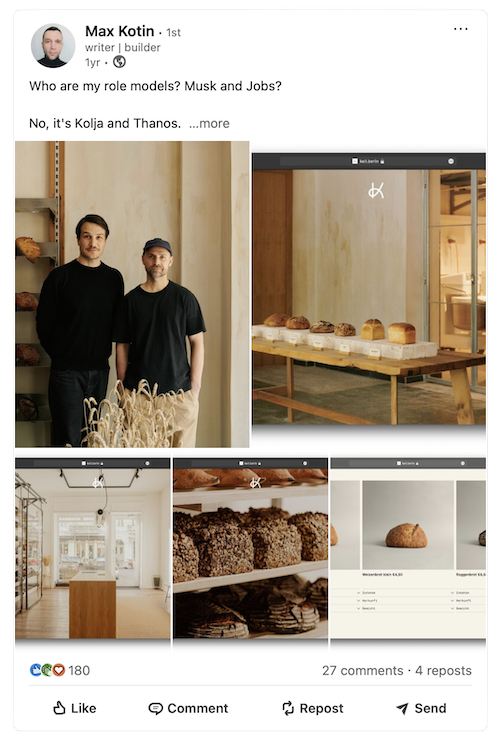
They say, social media are destroying our democracy and our civilization. Maybe so. But it’s also true that they can connect us and make our lives richer. It’s up to us to decide how we want to use them.
Let’s connect. Find me on LinkedIn.
Illustrations for this post were generated by AI. They serve as a homage to the German painter Paul Klee (1879-1940), replicating his unique style. Check out his works here.